That said, I have long been a voracious consumer of photographs. (Hmmm... that might explain why I wasn't much of a reader until later in life!) I regularly pored over the pages of my parents' photo album, wondering about the people in them that I'd never meet—relatives included—and imagined myself as "being there," thanks to the science that made it all happen. We regularly had slideshows at home after Mom's most recent roll(s) of Ektachrome came back from Kodak, so to a degree, the notion that photographs were a big deal was instilled in me pretty early on in life.
In the spring of 1968, my older brother Mike brought home his high school yearbook, and I dove into the book's contents as if it were my own because... pictures! Of course, I knew many of the people in his class since we had attended the same grade school (albeit with a three-year difference in our ages), so it was fun to see their faces as I leafed through the pages—my egocentric self considered they were my friends as well. I knew these people! As a Freshman less than two years later, I would pester many of them during their Senior year—I was dubbed "little Powers."*
But I digress...
Almost immediately upon opening the book, my curiosity was satisfied, for there—spread across pages 6 and 7—was this fisheye view of the entire student body, faculty, and administrators of the school, taken from the rafters of the gymnasium at Cardinal Stritch High School in Oregon, Ohio on 15 February 1968 by Robert A. Packo**, whose two sons, Mark and Kirk—Senior and Freshman, respectively—were enrolled at the school. It grabbed my attention and took a firm hold on my imagination. In the years since, I have gone back and forth between wanting to have been a part of the student body and wanting to have taken the picture.

It was one of the most clever things I'd ever seen. Of course, my limited knowledge of photography at the time meant that I had zero clue as to what would have been required to take such a photograph. In my mind, the people all assembled in the gym, and the photographer merely lay down on the catwalk and pointed his camera down and snapped off the frame(s). Very simple. Very easy. It didn't occur to me the amount of organization it surely required to get everyone to assemble in a near-perfect circle. (As I write this, I imagine that once the camera was in place, and well before everyone entered the gym, Packo had already determined what the outer limits of the frame were, and marked off the floor so that people kept inside the line.)
Years later, while at Bowling Green State University studying Visual Communications Technology, one of my require texts for a photography class was The Camera, one of the sixteen volumes which made up the LIFE Library of Photography. About halfway through the book, I discovered this...
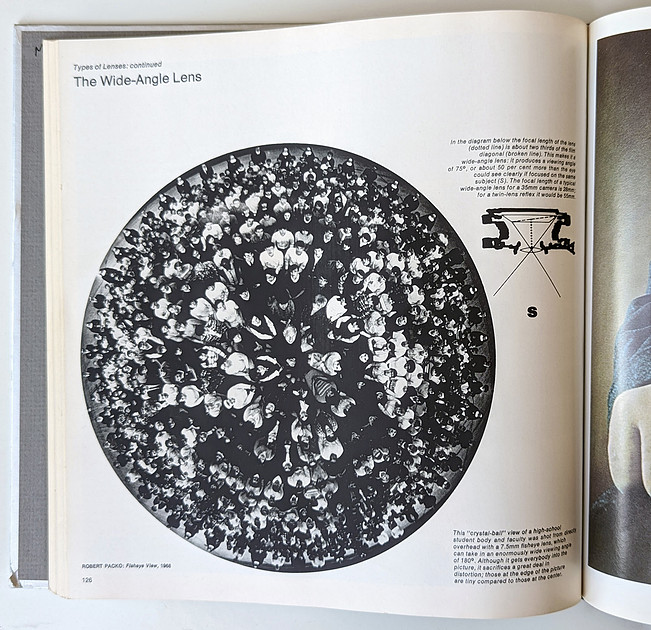 The text reads: "This 'crystal-ball' view of a high-school student body and faculty was shot from directly overhead with a 7.5mm fisheye lens, which can take in an enormously wide viewing angle of 180°. Although it gets everybody into the picture, it sacrifices a great deal in distortion; those at the edge of the picture are tiny compared to those at the center."
Seriously, who cares about the distortion?!? It's a great photograph!!
Students were arranged by seniority from the center out—Seniors to Freshmen—so those at the outer edges are less recognizable unless you happened to have been amongst the group and remembered where you stood as the picture was taken. (I'm pretty sure, though, that I'm able to recognize my brother somewhere around the outer edge—he was a sophomore—in the upper-right area.)
Now that I'm much more aware of the nature of lenses (as well as the difficulty of arranging people for even the smallest of group photographs), I have a better idea of the technical aspects of the project. Assuming that the image is full-frame, the camera had to have been suspended from the catwalk in order to get as close as possible to the people in the center of the image so that they weren't tiny, particularly the school's principal, Monsignor Michael J. Walz, while still being off the floor enough to get everyone in the frame.
Anyway, it was very cool that a photograph I'd long admired had made it into a national publication.
As of a few days ago, that's where I expected the story would have ended. But I recently obtained about twenty issues of Cardinal Stritch's student newspaper, Essence, and was delighted to see a story about the photograph and how it came to be. While it's missing a lot of details that I'm hungry to know, I was somewhat surprised to see that it was a much greater undertaking than I originally thought. (Side note: given the now regular occurrence of school shootings, the header of the article is a tad disconcerting.)

$24,000 worth of equipment! That equates to over $211,000 in 2024's currency! I would guess that Nikon sponsored the use of the lens. Likely, Packo received support from Kodak as well. Was most of the rest of the gear mounting equipment? The description in the above article that the equipment was "mounted on a ladder and placed on the gym rafters" doesn't really begin to describe what had to have been going on. By using a remote control, how did he frame the photograph? Were there trial runs earlier in the week without people present in order to get used to the set-up? If he used both colour and black-and-white film, he must have taken at least twenty exposures (the norm for a short roll of 35mm film at the time) of each in order to use up the two rolls. That means that there were "outtakes"!! How much trouble was it for him to change rolls of film? Were there TWO cameras set up side by side? There are SO many questions!
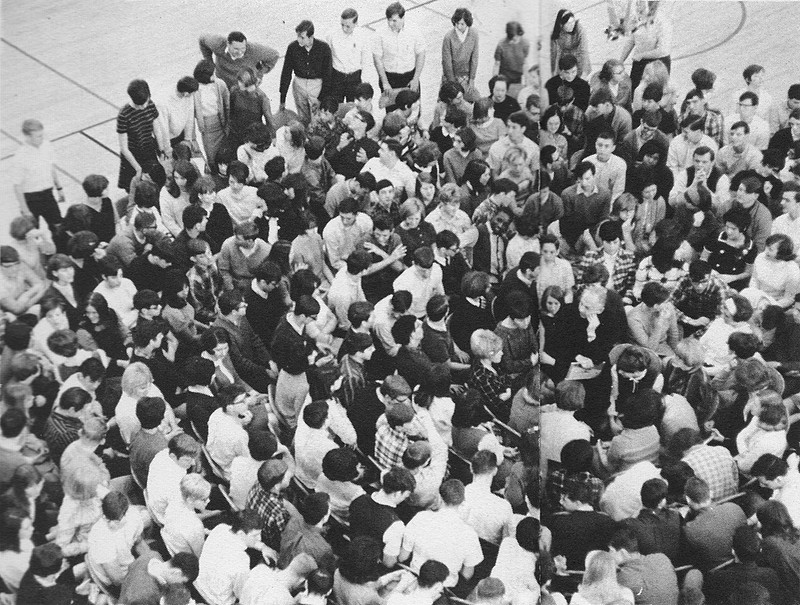 The above photograph was also scanned from the yearbook (unfortunately, it also runs across the book's binding). It was taken by Packo (or possibly one of his sons) as the students got themselves assembled. I originally thought that people mostly stood for the photograph, but clearly, the preponderance of people sat, which probably required using almost every available chair in the school. How many candid photographs were taken that day and what became of them?
I wish I could find an original copy of the photograph. Packo died at 52, just twelve years after taking the photograph. His eldest son, Mark, followed in his photographic footsteps, but his career drifted more to graphic design; his younger son, Kirk, became world-renowned in the world of ophthalmology, so I wonder what became of their father's archive of negatives and file prints.
Out of curiosity, I dug up Robert Packo's obituary [The Blade, Tuesday, 21 October 1980, Toledo, Ohio] and found he'd he accomplished quite a bit in his fifty-two years of life.

UPDATE (14 February 2024): After writing this, I scanned the reproduction of the photograph in sections at 4800 dpi and posted them in an alumni group at Facebook. I thought it would be fun—especially for the people who participated in the photograph, but also for me—to identify as many people as possible in the image. Since the people at the center of the image were Seniors, and have the most recognizable faces due to their proximity to the center of the lens, it was mostly people from that class that chimed in to identify themselves and their fellow classmates.
But something wasn't quite right. As people identified a classmate, I would look at that person's Senior portrait sort of as a means of verifying things. I soon noticed that—to a person—the parts in their hair in the fisheye image did not match those in the portraits. That means that the published image—both in the yearbook and in the LIFE book—was flipped from how the photograph was taken. I also managed to find someone with a pocket on his shirt—it was on the right (read: wrong!) side of his shirt. Mike Sarra identified himself in the photo and confirmed for me that his part in the photo was not as he parted his hair. I found further evidence that the photograph had been flipped when I saw the above candid photo that was taken as people took their positions.
 In the image on the left, note the girl in the checked jacket (Barb Mauter) in front at left. The person to the right of her has light hair. In the detail taken from the non-fisheye image, there's a dark-haired girl on that side; the light-haired girl looks also to be on the opposite side of her. Also, over Barb's left shoulder in the fisheye view is a girl in a white top—she appears over Barb's right shoulder in the candid photo; similarly, the fellow with the checked shirt over that girl's left shoulder appears over her right shoulder in the candid photo.
Further evidence of the fisheye photo having been printed backwards... Eileen Simon (checked jacket below) appears to the left of Mike Brimmer (light shirt) in the fisheye image (left), but are reversed in the candid photo. I've yet to identify the people next to them, but clearly the girl with the patterned sweater who is left of Eileen in the fisheye image is right of her in the candid photo; likewise for the fellow to the right of Mike in the fisheye image. (The photo is printed across the yearbook's gutter, hence the blurriness and imperfect rendering of the fellow next to Mike.)

My initial thought was that the image accidentally got flip-flopped when it went to press for the yearbook, but what are the chances that the accident happened both times it was published? And by TIME-LIFE books no less? C'mon... if anyone knew what they were doing, it was TIME-LIFE. So I have to believe that Packo made the decision to print the photograph backwards, although why, I wouldn't know. But then I thought: did he do his own printing or have a technician print it? I doubt that a technician would have made the decision to print it backwards, and if he/she was a technician of any calibre, printing it backwards would have meant straying from standard procedure of placing the negative's emulsion down in the negative carrier.
Another possibility, I suppose, is that Packo printed a film positive to send to the printers and somehow accidentally mis-identified the right-reading side of the image. I think that's a bit far-fetched, though. The other possibility that might make sense is that he didn't like the direction the school's principal, Monsignor Walz, was facing. This also seems a little far-fetched, but I feel as though an aesthetics choice was more likely than a mistake made in any of the labs during the production of both publications.
This annoys me. It annoys me because all too likely, anyone who had anything to do with this photograph getting to print—either as a glossy print for display or for photo-offset reproduction—is not around to answer as to why it's backwards in the publications. Were enlargements for display printed backwards as well? Both of Packo's sons have died, and I wouldn't have a clue as to how I might determine if he employed a darkroom technician.
UPDATE II (16 February 2024): A few days ago, I attempted to contact Robert Packo's namesake grandson, who works in photography and video production in Chicago, thinking he might have inherited something from his grandfather's estate, but I had no luck. So, I thought I'd get in touch with people who might be in touch with him. Ultimately, my contact information was shared with Mike Momenee (who is somewhere at the outer edges of the fisheye image), who was college roommate and best buds with the elder Robert Packo's son Kirk. Mike called Kirk's widow to see if she knew anything and then he called me. Apparently, after Packo died in 1980, the decision was made to get rid of everything... cameras, lenses, equipment, negatives, file prints... EVERYTHING. Considering both of his sons' very successful careers, wading through what had to be thousands upon thousands of photographs would have required way too much of their time. There are a few things of Packo's available at eBay, and I've contacted the sellers to find out where they'd obtained their items. Only one attended the estate sale, but that person appears to have been more interested in non-photo-related ephemera. It occurred to me that maybe an original copy of the photograph is extant at TIME-LIFE Books, but a quick search rendered what I'd known long ago, really, that the publishing entity had been sold a few times and no longer exists. I remain convinced, though, that at least one copy of the print remains out there somewhere. I hope, too, that the candid photos taken that day exist somewhere.
I also heard from Bernie Soltis Kennedy, who told me she'd worked for Packo at that time as a secretary/office helper. She told me that Packo did all his own printing, so I guess that removes one of the variables.
*there is no S on the end of our name, but what are you going to do?
**Packo's father was Tony Packo, whose restaurant was made world-famous by Jamie Farr on the CBS television series M*A*S*H.
 Up Lomita I trudged (at 67, walking uphill = trudging!), and while I have tended in the past to take the steps that lead up from 14th Avenue, which is on the east side of the hill, I opted for the sunlit west-side route, 15th Avenue. There, I thought I'd use the PhotoSphere mode of my Google Pixel 6a (which is designed to create 360-degree images I discovered just a day or so ago) to do an in-camera panorama of the hill I had left to climb.
 After making it to the top of the hill, I took a bunch of frames for panoramas of one of my favourite views of the city, with this one being the best of the bunch. I still can't get over the fact that views like this exist but a couple of miles from my decidedly urban neighbourhood.
 The last time I made the trek to Grandview Park, it was windy and cold. In fact, it's been windy most times I've gone there, but not this time. I didn't feel even the slightest of breezes. The clear sky, pending sunset, and warm temperatures meant others would be enjoying the park.
 Deciding not to stick around for the sunset, I made my descent, and saw this fellow enjoying what might have been a cup of coffee as he seemed to be waiting for the sun to sink below the horizon.
 There is a tree which sits in the middle of Moraga Street where it meets 16th Avenue, and I have photographed it often, but never quite to my satisfaction. This time was no different, really, but I couldn't help myself. I probably should take the Nikon with me one of these days as the mobile is just too limited in its capabilities.
 On the way back to Judah Street to catch the N home, I tried another PhotoSphere panorama, inspired by the massive array of wires emanating from one of the utility poles on 18th Avenue. I knew that the wires would create stitching errors within the final image, but I think the splaying of the wires in every which way looks pretty cool.
 When I moved to San Francisco thirteen years ago, I often felt frustrated by the omnipresence of the overhead wires and how they would—in my mind at the time—ruin perfectly good photographs. But over time I've come to make peace with them and work with them instead of against them.
 *A funny thing about the "hidden" steps is that there is a big sign at 16th Avenue and Kirkham Street which reads: Hidden Garden Steps
]]>
The point I was beginning to stray from was that there were numerous trends and memes that got started at Flickr. Some were very silly...

One that was quite cool but was not, I guess, a Flickr thing, consisted of self-portraits taken by people in basically the same place with the same pose— very passport-like in style—looking straight into the camera, for years on end. Watching someone's face and hair (whether on one's head or face) change in the form of a rapid-fire video was quite the sight to behold.
From that, I guess, grew the 365-day projects, some of which were self-portraits. One person, Phillip Chee, has been doing 365/366 Projects since 2007, his first being strictly self-portraits. I tried this the year I turned 50, with a thing I called Daily 50, but missed maybe a week's worth because I wasn't clever enough to really produce interesting self-portraits daily, and because I sort of got sick of it before too long and would just sort of forget to do my photo for the day. One friend of mine has chided me about it as being narcissistic, and while I guess a case could be made for that, I found it as a way to do portraiture, to play with lighting and processing techniques, which were quite new to me at the time. Also... I was my most convenient model. Had there been someone else available and willing to partake in such a project, I would have preferred that route.
All that said, I never got around to completing a project in which I took and posted a photo a day until 2017 on Instagram (if you don't have an account, you'll only be able to scroll so far). In 2020, I did an entire year's worth of photos that I ran through the Prisma app, which "artified" the photographs. I actually liked the results most days, but beyond the final images created, it was a rather grueling mental process looking for scenes that I thought would translate well to "art". I became intent on including (often solitary) people in my photographs during this project, as it added a dynamic that I think made the images more interesting. It also was grueling as I tried out various filters to see which one I liked the most, this while also wanting to not use the same filter day after day because yes, there were some which were consistently better in my mind. This process was time consuming, so I was quite glad when the year and project were over.
For 2021, I decided to do a year of only black-and-white photographs. While there was a similar taxing of my brain as I looked for subjects to photograph that would render well in monochrome, which often meant eschewing really colourful stuff such as murals, the time spent on editing the images once I selected them was less of an investment of my time than had been the Prisma set. If I spent any length of time on the postings, it was with the writing of the descriptions, which I've tried, loosely, to use as a journal of sorts when the Covid-19 lockdown began in March of 2020. I tagged all the photos at Instagram with #ptpower2021inblackandwhite, but have also created a gallery on this site here so that it can be viewed somewhat in its entirety, albeit separated by months. I intend to create similar galleries for 2017 and 2020.
I'm choosing not to be as narrow with my project this year. There likely will be a good mix of black-and-white and colour, maybe with some Prisma conversions thrown in. I won't bend on the square ratio because I'm weird that way, although I guess I dance around that a bit when I post panoramas divided into two or more squares. I'll probably be more apt to post a series of photos from any given day, especially on days I happen to go out for long walks.]]>
I've not done a huge amount of traveling in my life, but expect a gallery of photos from Paris, as well as some from New York City, Chicago, Oslo, and Prince Edward Island, amongst a handful of other places. Of course, there will be an immense collection of photos I've taken in San Francisco since I moved here that are somewhat off the proverbial beaten path; likely there will be some of the popular landmarks tossed in.
2022 here we come!
]]>
In January of 2010, I moved to San Francisco. At the time, I coördinated the music for the now-defunct Great Lakes Folk Festival. Most of my work was done either online or over the phone, so it allowed me to take the leap of moving cross-country from East Lansing, Michigan. I also worked as a photographer, mostly covering events for a few departments/colleges at Michigan State University. So, the move to San Francisco meant giving up a modest amount of client work in the hopes of building a client base in a much bigger, conference-friendly city.
It was a very, very slow go.
To help make ends meet, I was fortunate to get several months worth of relatively well-paid work with the Census Bureau for the 2010 Census. I also ran errands for people. I put IKEA furniture together. I answered Craigslist ads looking for photographers, and posted my own ads looking for work. As best as I can find, I didn’t do any photography work until October of that year, and even that was a freebie portrait session with a woman as a matter of building portfolio and possibly getting my name out there. I did another freebie session with a couple whose wedding I would photograph the following September. My first paid gig was of a "Cupcake Challenge" event in March of 2011. I had responded to a Craigslist ad for a beer festival in October of 2010, and while I didn’t get that job, the fellow who placed the ad had kept my name and email at hand. Foot-in-the-door type stuff, right? Except that it didn’t seem to lead to anything.
On 8 October 2011, I got a Facebook message from one of my long-time Flickr contacts, Liz West (Muffet), who was in town, and she asked me if I were available that night to photographer her brother’s 70th birthday party. Liz’s brother is actor/activist/author/Ken Burns documentary voice, Peter Coyote, something Liz had mentioned in her Flickr stream years earlier, but never had made a big splash about. About ten minutes after I responded to her message that indeed I was available, Peter himself called me to ask if I were available and how much I’d charge. My evening was set.
To be completely honest, when I ended the call with Peter, my mind was on getting everything ready. I probably washed clothes and charged batteries for both the cameras I’d be using, along with the flashes, just as I would do for any other job. I gave not one moment of thought about what to expect that night. Not for a second did I wonder about who might be in attendance. When I arrived at the venue, Bimbo’s 365 in North Beach, I was immediately greeted with the sight of Robin Williams cavorting with people in the vestibule. (Oh!) Once I got situated, I started taking photos of the growing crowd that was mingling, being sure to snap a couple of frames of Robin amongst them because… of course.
 Once the evening’s program commenced, and once everyone filed into Bimbo’s ballroom, I went about doing what I do — documenting what was going on as well as many of those in attendance. I didn’t give much thought as to who they might be. (The only other person I recognized was poet Michael McClure.) A band performed; a gorgeous woman sang; there was dancing. As I meandered about the ballroom, taking photos at this table and that table, at no time did I happen to see (much less look for) Robin Williams.
The time came for the birthday candles to be lit and blown out, and for the next forty minutes or so, various people, including his children, gave tributes to Peter. His wife sang a song for him. The last to give tribute — in the form of a short stand-up routine, of course — was Robin. (I tried to record some video but because I wasn’t familiar with that feature of the camera I was using, failed miserably, getting only nine out-of-focus seconds worth.) I got a few photos of him from a couple angles, but nothing special, really. It was sort of odd that Robin had been one of the first people I’d seen that night, but until he’d gotten on stage, I had not crossed paths with him once in the duration, regardless the number of times I circled the ballroom.
Once the formalities had ended at around 11:00, I was pretty much off the clock, so I grabbed a little something to eat. I’m unsure exactly how it came to be, but I’m pretty sure I was on my way back from the bathroom when I found myself walking virtually side by side with Robin as we both headed in the direction of my table, which was near the buffet. Seeing Peter ahead of us dishing himself a dessert, I lightly put my hand on Robin’s leather-jacketed shoulder and asked him if he wouldn’t mind me taking a photo of him and Peter. He obliged. In the course of twenty-four seconds, I snapped off three photos — the second one, although slightly un-sharp, did the trick.

Postscript: I originally wrote this for Medium, after posting the photo in reply to a Zak Williams’ tweet marking the seventh anniversary of his father’s death. I was satisfied that I was done by the time I went to bed, but didn’t get around to publishing it. The next morning, as I was scrolling through the daily Facebook memories notifications, this one appeared…

]]>
]]>